

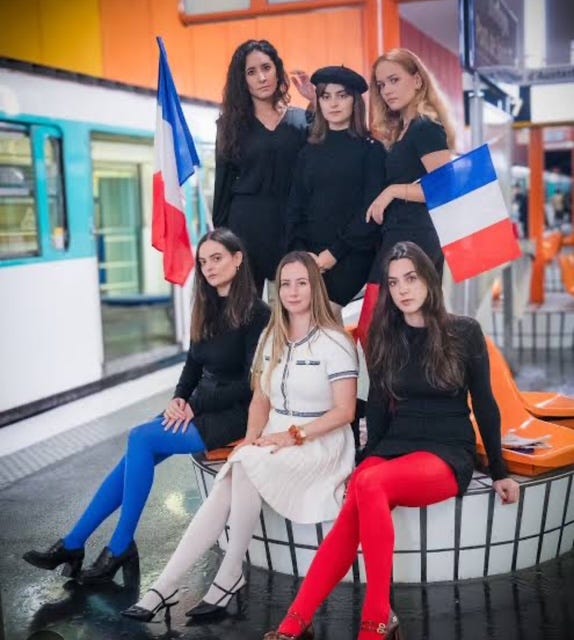
I assume you have never heard of the French women’s organization Collectif Némésis (the name is taken directly from the goddess of vengeance – which already says a lot!). I hadn’t either, until the fatal assault of 23-year-old student Quentin Deranque, who on Saturday, February 14 tried to protect the girls during a demonstration when an aggressive mob of left-wing extremist Antifa activists attacked them. Quentin was beaten so badly that he later died from his injuries, and nine people have now been arrested for their involvement in the assault, which was also captured on film. Through Quentin’s tragic death, Collectif Némésis suddenly appeared on many people’s radar.

Collectif Némésis is a group of angry, unruly young women who raise issues that are not very comfortable for the establishment, as they openly defy the left-liberal narrative, and therefore they are ignored.
“We started with absolutely no support, no one on the right even knew who we were, and some of the activists had to leave their jobs,” the founder Alice Cordier told AFP last year, adding that the collective received no subsidies.
Swedish mainstream media will of course not pretend this organization exists. Alternatively, they will soon describe it as “far-right.”
Yes, Collectif Némésis is a veritable slap in the face of the politically correct, left-feminized establishment. And they are needed. These girls are the real women’s fighters of our time. They dare to go against the current. They raise issues that truly sting. They are not as miswired as the brainwashed preschool teachers at Dagens Nyheter or the timid church ladies at SVT and SR.
“Feminism has for decades been the domain of the left, and the left does not realize that there are now new factors to take into account, particularly regarding migration,” continues Alice Cordier.
The women in Collectif Némésis are tough. They speak the truth even when the price is high and the establishment turns against them. Because it is not comfortable or pleasant to protest against mass immigration, Islamization, and policies that have turned Europe into a hell where women are sacrificed on the altar of multiculturalism.
The media are of course partly responsible for the situation we are in, continuing to force-feed the population with distorted and misleading reporting. Today it has gone so far that only certain selected feminists are given space in establishment media, and young girls are indoctrinated into believing these are the norm to emulate. Either left-wing activists like Greta Thunberg are uncritically elevated as role models regardless of which extremist organizations they support, or the focus is on curated influencers whose biggest concern is whether their next paid collaboration will go through.
Mainstream media love to showcase hypocritical left-feminists and their agenda: that mass immigration and multiculturalism are desirable, that the climate is in a state of emergency, that criminals need cinnamon buns and a warm embrace after executing someone with a bullet to the head, that trans activism must be treated as the most important issue of our time, and that even men who pretend to be women can give birth. At the same time they claim that forced veiling and increasingly aggressive Islamization are good for a modern society and pose no problem to Western women’s freedom.
No alternatives are offered in this echo chamber of distorted opinions. Girls and women who think differently are cancelled from the public conversation as if they were suspicious or crazy, and are then relegated to alternative media. They are portrayed as cold-hearted, ridiculed, and questioned by the establishment.
Collectif Némésis gives all of that the middle finger. The confused ideas promoted by the left’s lackeys – which are in fact the greatest threat to women’s freedom – have no place here. And that is liberating.
Background
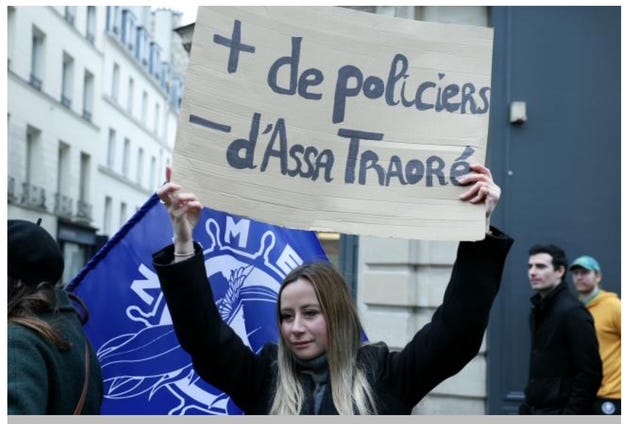
Collectif Némésis was founded in France in 2019 by a young activist using a pseudonym, 28-year-old Alice Cordier, presumably because it is too dangerous to act under her real name. The group has since established itself in France and, to a lesser extent, in Switzerland and Belgium. It is relatively small, with an estimated 100 to 300 members, of whom a core group of a few dozen women drives the work. Members are mainly between 18 and 30 years old. At the same time, the movement has a much larger digital reach, with tens of thousands of followers on social media.
Because today’s modern information war is largely fought on social media. And it is through social media that one can reach and influence especially young people. On X, CN has over 120,000 followers, and over 100,000 on Instagram.
Collectif Némésis represents a new feminism, a far healthier ideology than the stale old kind tainted by Islamist appeasement and hostility toward the nuclear family. This new, perhaps sixth-wave feminism differs clearly from the one dominating Western European media and institutions. I would argue that CN is what feminism was originally meant to be: a justified struggle against injustice and oppression that strengthens women without automatically turning into a war against men – with whom we should instead stand together today against forces trying to destroy everything worth living for in a free society, such as freedom of speech and freedom from religious oppression.
In other words, everything that is destroying our societies and that women suffer most from, as our freedom is increasingly restricted due to an influx of dysfunctional cultures that are spreading and attempting to dominate our previously safe societies.
Of course mainstream media hate CN. They want to highlight how women of all ages are subjected to unprovoked violence, new forms of sexual assault, lack of safety in public spaces, and the role of cultural norms in women’s security. A central part of their message is the link between women’s vulnerability and migration, especially from non-European countries – something our politicians prefer to ignore.
Because CN makes this connection openly and unapologetically, the organization is described as “controversial.” Despite statistics and facts supporting their claims, they are questioned and smeared, just like all movements that defend nation states and common sense. The politically correct crowd labels them with the term “femonationalism” and seems shocked that feminist arguments are used in a nationalist or migration-critical context.
They are dismissed as identitarian, far-right, and Islamophobic – the usual rhetoric whenever something challenges the left-leaning globalist agenda. Several established feminist organizations in France have of course distanced themselves. And it is striking that the reaction often consists not only of criticism but also silence and marginalization. Instead of engaging with the issues raised, parts of the public debate simply try to ignore or silence them.
Cancel culture is alive and well, and CN firmly steps outside the European “opinion corridor.”
Personally, I can only say: Hallelujah. Finally a group of young women who seem to understand what truly threatens women in the West, and who stand firm against a destructive establishment.
We must ask ourselves: Which women’s voices are considered legitimate, and which are considered misguided, dangerous, or unworthy of being heard?
I myself, and for example The Swedish anti-sharia networkKvinnokraft 4.0, are not considered worthy of serious attention by the left-leaning establishment. Those of us who highlight how badly women suffer in a society that is being Islamized – where individuals with medieval patriarchal values believe they have the right to control women’s lives – are targeted by the left’s megaphones such as Swedish Radio, SVT, Aftonbladet, Dagens ETC, Flamman, and Expo.
For nearly ten years I have stood up for girls and women, fighting to keep Sweden a country where we can live safely instead of being subjected to gang rapes, assaults, and violence that follows in the wake of the demographic changes our country is undergoing.
Already in 2017–2018 I wrote about the women’s appeal #120dB, which gathered testimonies from girls and women subjected to sexual assaults in public spaces, festivals, asylum-related environments, and across Europe. The name symbolized the volume of an alarm – a cry for help that cannot be ignored. The testimonies were concrete and painful. Even then, Europe’s daughters said they were under attack. Yet the appeal did not receive the same unanimous support as the diluted #MeToo and its many spin-offs. The reactions were divided, sometimes dismissive. There was a clear tension between women’s experiences and the dominant political narrative. It was not acceptable to speak about immigrant violence against Europe’s daughters – and it still is not.
Nearly ten years have passed, and the situation is even worse. The elephant in the room – mass immigration and men from cultures that treat women as less than animals – remains. And the establishment is terrified of being accused of racism if these factors are discussed.
Who gets to decide which experiences are given space, and which are deemed politically inconvenient?
Collectif Némésis is not just an organization, but a symptom of a broader shift in the European conversation about gender, migration, and culture. The fact that a small movement can achieve large reach through social media shows how parallel public spheres are emerging. Issues ignored by mainstream media become major topics online.
Of course one can criticize Collectif Némésis ideologically or politically. But ignoring them, or dismissing the experiences they refer to, undermines trust in public discourse and reinforces the sense that some women’s experiences matter less than others.
At its core, this is about feminism’s fundamental purpose: to make visible women’s experiences of violence and insecurity. If that mission is constrained by ideology, feminism becomes dishonest and irrelevant.
Collectif Némésis points to a crack in the conversation about women’s safety in Europe – a crack involving equality, migration, and cultural norms. It will not disappear through silence.
The question is what it says about our public discourse that some women feel their experiences have no place – that it is considered shameful or racist to speak about the consequences of mass immigration and political cowardice.
This is something every woman who calls herself a feminist must think about.
Collectif Némésis are the real modern women’s fighters. I wish that all sensible women would unite and protest against mass immigration and Islamization. Then I might even consider calling myself a feminist again.
You and CN are the seed of a woman’s movement absolutely necessary for the survival, not only of women, but of western society and values. I would guess that introducing it internationally, to all western nations, would prove popular and beneficial to a wider female audience. Strength in numbers being the key to overcoming the government and collusive media narratives. I have been amazed, in the United States, at the audible silence of women as their rights are being eroded and ignored by immigration and trans policies. I would certainly welcome, and the female population would certainly benefit, from a CN presence in the western hemisphere. The same would be true of Canada. Nurture this seed carefully and aggressively please. It could become the single greatest female driven contribution to western civilization in history.
The feminist movement has become degraded and is no longer fit for purpose. Earlier it was about working rights not about rejecting men and families