

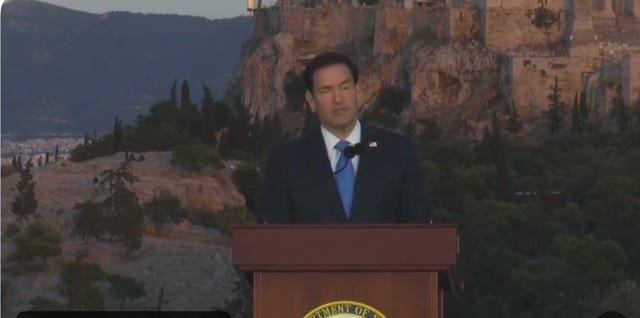
Nationalism has become a dirty word that the left uses to frighten the feeble-minded. Europe is tearing down its monuments, teaching children to be ashamed of their history, and handing over our sovereignty to global institutions. This message, which is unfortunately true, was delivered yesterday, October 7, by U.S. Secretary of State Marco Rubio in a widely noted speech in Athens. Noted by many, though not by Sweden’s mainstream media, which would rather bury this uncomfortable truth about how the Western world is ashamed of its own civilization, with Sweden occupying one of the leading positions in self-denial and some kind of bizarre shame over Swedish culture, nationhood, and identity.
Rubio delivered a powerful slap in the face, a reckoning with decades of Western self-criticism, globalization, and weakened national identity. With the Acropolis as his backdrop, he urged Europe to rediscover its strength, its pride, and its willingness to defend its own civilization.
“We began to be ashamed of the very things that made us exceptional,” he stated.
Rubio describes how Western societies gradually began to view their historical achievements with suspicion. How nationalism became a dirty word, monuments were torn down, and new generations were taught to be ashamed of their cultural heritage.
Yes, Sweden, I’m looking at you and your politically correct crusaders who have spent decades trying to annihilate everything of value that is Swedish. Reinfeldt tried to claim that anything purely Swedish was nothing but barbarism, and Mona Sahlin mocked Swedish culture. This self-destructive behavior has been painful to witness. Is that why the mainstream media are avoiding Rubio? Because he is poking precisely where it hurts the most?
In Sweden, national pride has long been a minefield. Defending Swedish culture, Swedish traditions, and Swedish history has in modern times been regarded as something suspicious. Racist, even. Preferably, the Swedish flag should not fly at all. Meanwhile, people from other countries are encouraged to preserve their identities. It is admirable to be a proud Kurd, Turk, Somali... But not a Swede. In Sweden.
But why must love for one’s own country be at odds with respect for other cultures?
Rubio’s criticism does not stop at culture and identity. He also describes how the Western world has opened its borders, moved industrial production overseas, weakened its defenses, and surrendered ever greater portions of its sovereignty to international institutions. Here, he touches on one of the most important democratic questions of our time: Who should actually decide a country’s future—its citizens or supranational institutions?
International cooperation can absolutely be a good thing. But as Rubio emphasizes: The purpose of alliances should be to defend the sovereignty of nations, not abolish it.
He also criticizes the Western world’s naivety when it comes to security policy.
“War did not simply disappear because we preferred peace.”
While Europe has been disarming, other powers have continued to strengthen their military capabilities. Russia’s war against Ukraine has brutally illustrated the consequences. But Rubio’s message is about more than defense budgets and border control. He is talking about a civilization that is losing faith in itself. For how can a society defend its values if it no longer dares to take pride in them?
Rubio’s speech is not just another political statement. He represents the U.S. government and is articulating a foreign policy vision that could fundamentally change the relationship between Europe and the United States. International media have reported on the speech. But in the Swedish debate, there is little interest in the ideological substance of Rubio’s message. Swedish media devote enormous amounts of coverage to Donald Trump’s personality, statements, and controversies. Yet when the U.S. Secretary of State delivers a speech on the fundamental principles concerning the future of the Western world, the silence is remarkable.
Europe is burning, France is shaken by riots, Islamists are marching through the streets of major cities, the suburbs are in revolt, and foreign powers are advancing their positions. That is precisely why Rubio’s message is politically significant. Historical awareness is not the same as historical self-loathing. It is possible to acknowledge the mistakes of previous generations while still taking pride in Europe’s contributions to science, art, democracy, and human rights. It is possible to defend national borders without despising other peoples. And it is possible to cooperate internationally without abandoning national self-determination.
This is precisely what Rubio is putting his finger on. And it is something the mainstream media should be eager to discuss. But instead, they remain silent, thereby playing into the hands of dark forces. Those who sow division and who are leading the Western world in entirely the wrong direction.
It's not nationalism we should be afraid of but socialism, especially on a global scale.