

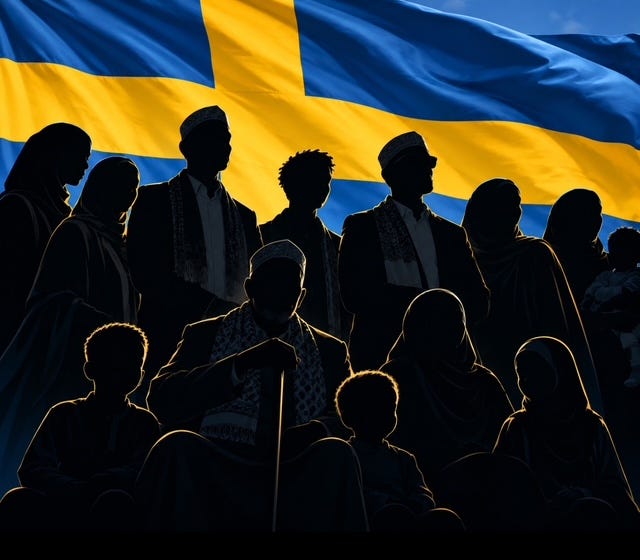
Sweden is right now shaken by a growing political scandal unlike anything the country has seen: suspected election fraud, pre-marked ballots, church-led voting convoys—and Somali clans using the Left Party and the Greens as a vehicle to seize Swedish power. The state has given tens of thousands the right to vote without knowing whether they can read a party program, a news story, or even the names on the ballot. The new “Swedes” thus become easy voting cattle—especially when they are threatened into voting red with propaganda and manipulative lies claiming that otherwise they will be thrown out of Sweden.
Week two of the post-election chaos in banana-republic Sweden. Still almost no one names the hippo in the polling station: the eligible voters (or those with false identities) who cannot even read the ballot in Swedish. And that is why I am more and more convinced that the non-literate citizens in the country—those who have been manipulated, bribed, and threatened in various ways into casting their votes for the parties that claim to want what is best for them, namely the Social Democrats and the Left Party—played a decisive role. At the same time, S and V went all-in to scare this group into obedience with outright lies about the Tidö government’s alleged hatred of immigrants and its vicious deportation strategy. In the ghettos—or, in politically correct Swedish, “vulnerable areas”—V and S were in principle completely dominant in 2026.
Taste the number. About 780,000 adults in Sweden—roughly every eighth person of working age—have insufficient reading skills in Swedish. Those over 66 are not included, but among them there are around 300,000 more foreign-born, many of whom have the right to vote and perhaps even weaker literacy than the already inadequate levels. How many can neither read, write, nor speak Swedish at a functional level is something official statistics do not tell us.
PIAAC—the Programme for the International Assessment of Adult Competencies—is the OECD’s survey of adults’ skills in reading, numeracy, and problem-solving. Statistics Sweden (SCB) conducts it in Sweden. It does not measure schoolchildren the way PISA does; it measures adults aged 16–65. The 2023 results are not secret: they confirm the figure that a staggering 780,000 adults have insufficient reading skills in Swedish. Among the foreign-born, 34 percent are at level 1 or below. Among the native-born: 4 percent. Among foreign-born men: 40 percent. Among foreign-born women: 29 percent. In areas with large socioeconomic challenges, roughly half of foreign-born adults have deficient reading skills in Swedish. Some can read Arabic, Tigrinya, or Somali. That is not enough when the election is held in Swedish.
During the Tidö years, roughly 205,000–208,000 Swedish citizenships were granted. SCB’s calendar-year figures give a rough picture of the pace: 67,800 in 2023, 63,000 in 2024, 37,500 in 2025. The drop in 2025 was mainly due to longer processing times and tighter identity checks. Language and civics tests for citizenship were only introduced on June 6, 2026. Almost the entire Tidö cohort was therefore let in without any requirement that they be able to read a ballot. SVT Verifierar calculated that around 64 percent of the new citizens during the term had a non-European background. The largest groups: Syria, Eritrea, Afghanistan, Somalia, Iraq. A quarter were minors on election day. But the rest—adults in the hundreds of thousands—had the right to vote. And thus the power to redraw Sweden’s political reality.
How many of them can read, write, and actually understand political information in Swedish? No one knows. It is not measured when citizenship is granted. PIAAC only tells us how many foreign-born 16- to 65-year-olds sit at level 1 or below in Swedish reading—and that the share is around half in areas with large socioeconomic challenges. Countries with high illiteracy in the origin population (Somalia, Afghanistan, parts of Eritrea and Syria) are overrepresented among precisely these new citizens. The state has therefore given voting rights in parliamentary elections to tens of thousands of people without knowing whether they can take in a party program, a news article, or even the names on the ballot.
We do not even know exactly how many people are in Sweden. There has been no modern census. The population register counts those who appear in the records. The undocumented, false identities, and double registrations fall outside. Migration policy has for decades been lax enough for the volume to grow, and careless enough that language never became a condition for voting on Sweden’s future.
Our society and our power-holders, who have not kept up with the development they themselves created, refuse to connect reading and writing ability in Swedish with cultural identity and integration. But with an ever-larger immigrant population, these factors are decisive for what political control of Sweden will look like. As long as this is swept under the rug, no one can say exactly how many eligible voters lack functional literacy in Swedish—and also lack interest in and loyalty to Sweden, Swedish democracy, our laws and rules, and the principles that apply, written as well as unwritten.
What we know in hindsight, with hard numbers, is where the immigrant votes went. Among voters with a non-European background, S and V alone took 59 percent. The red-green bloc landed around 70. In Rosengård centrum, Rinkeby, Spånga-Tensta, Vivalla, Hjällbo, Angered, and Tjärna Ängar, S and V were in practice the only game in town. In some precincts over 90 percent.
Many of us have seen the danger of clan voting and manipulation. In 2018 the first Somali preference-vote rocket, Leila Ali Elmi, entered parliament. One of her 2019 motions was that people should be mapped by race. Many of us understood that this was only the beginning. Unfortunately we were right.
On September 24, Peter Wennblad wrote in Svenska Dagbladet what staff in Järva have seen: over a hundred Eritrean women in Husby, shepherded by two priests, all the same party. In Rinkeby, people with poor Swedish who were supposed to put a cross next to “number eight”—the Left Party’s Ilyas Hassan. The election board is said to have called the Left Party repeatedly. The election was neither free nor fair. At the same time the suspected election-fraud scandal in Borlänge continues. There the unknown Mohamed Abdukardir Ali (V) preference-voted his way into parliament with 648 votes from ninth place. Police watched rides to the Kupolen mall, pre-marked Left Party ballots, and reports of money. A known criminal is pointed out. The investigation was closed before the election, reopened after, and is now with the National Operations Department. No one formally suspected. Both Ali and Omar deny it. Both have taken timeout. Both cling to their mandates and are said to be unsackable. How so? Even if they turn out to have committed crimes?
The Left Party’s statement came after Nooshi Dadgostar had stayed silent for almost three days and posted rainbow-colored dolphins on Instagram. Of course the racism card flew out. No desire to investigate Järva or Borlänge. Party secretary Maria Forsberg called the revelations insinuating and a smear that threatens democracy. The establishment’s only argument is the same as always: scream racism, call the witnesses haters, call the women free voters, call Tjärna Ängar an ordinary Swedish precinct. Then lid on.
But the facts remain: Anyone who cannot read Swedish news, party programs, or the fine print on the ballot is at the mercy of clan members, priests, imams, and other authorities. It is fear, rumors, threats, bribes, rides, and promises. Who dares say no to an authority figure who tells you that you must obey? Women in particular are exposed, and witnesses speak of them too. Exclusion behind the veil, polarization, and at the same time men who traditionally decide. Group pressure and the norm rule. Of course you vote for what you are ordered to vote for.
Democracy presupposes that the voter can check what is being said. When a growing part of the electorate cannot do that—when priests shepherd women to the urn, when pre-marked ballots and cars appear in vulnerable areas, when an investigation is shut down just before the election—and when power answers with the racism card instead of with numbers, the election is already lost and democracy is dead. Only wreckage remains.
Sweden, we have a problem.